

Gate open, boarding, last call…. and you’re 12 mins from the gate, halfway through your chicken sandwich. Panic hits, and you drop everything and run. You get to the gate and are met by a plane load of passengers with no signs of boarding in sight.
We’ve all experienced this sudden panic and frustration situation, when in fact there was no urgency at all. If you think about it, is this an airport operations problem, or an airline communication problem or even a data sharing problem? At the end of the day, it doesn’t matter – the passengers experience was degraded and the airport missed out on some additional revenue!
Airports are no longer merely points of departure and arrival; they have evolved into dynamic transportation hubs where passengers increasingly seek valuable and seamless experiences beyond the flight itself. More than just transit points, airports are powerful economic engines, acting as critical gateways that unlock new tourism revenue and fuel national prosperity. Meanwhile, there is pressure for investments in digital infrastructure to support growing capacity demands with a staggering 12 billion passengers annually predicted to pass through airports in the Asia-Pacific and Middle East region.
Consider the visionary scale of Changi Airport’s Terminal 5 (T5) in Singapore, a multibillion-dollar endeavour that commenced construction in 2025, designed to boost annual capacity by 50 million passengers and significantly enhance the nation’s tourism landscape by the mid-2030s and beyond.
It is clear, that to meet the needs of the growing demands of air travel the modern airport needs to evolve into a digital ecosystem. But where do you start? That’s why we have developed Cisco’s Airport Modernization Blueprint to provide a solid foundation for customers to build their digital journey.
Cisco’s vision for an airport is to provide seamless, secure, and memorable air travel experiences for passengers and to serve as a convenient commercial hub for nontravelers. It is designed to serve as the ultimate commercial experience center for all consumers, while also providing reliable, secure, and efficient services to airlines, passengers, non-passengers, and retail and hospitality business owners. Additionally, it aims to simplify airport operations through focused automation, observability, and AI-driven solutions.
Cisco’s solution blueprint for the airport of the future is referred to as ASCEND (Airport Secure Connected Environment for next-generation Digitalization). This white paper delves into how airports can navigate this complex, high-growth environment, transforming challenges into opportunities through strategic technological investments and exploring the critical strategies and technologies required to navigate this new era of aviation.
The ASCEND framework describes an end-to end digital infrastructure capability required for modern airport deployment built on 5 key pillars:
- Secure AI-ready availability zones to facilitate critical resilience across various geographies
- Secure, high-speed, resilient networks to facilitate high-speed communication across various systems and subsystems
- Contextual observability to provide context to airport operations as well as business data
- Cyber resilience powered by zero trust to secure the airport digitally and improve its posture against attacks
- AI-driven operations to enable simple and scalable airport operations
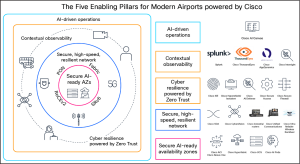
Cisco’s solutions blueprint for the airport of the future is referred to as ASCEND (Airport Secure Connected Environment for Next-gen Digitalization)
Cisco is playing a key role in the digital transformation of airports, enabling customers to take advantage of digital technologies such as AI and IoT that revolutionizes operations, elevates the passenger experience, and safeguards critical infrastructure.
For further information: LINK TO ASCEND


