
As an engineer, I have always been skeptical of marketing buzzwords. Nowadays, we see ‘AI’ slapped onto everything from IT systems to toothbrushes. But the shift toward Agentic AI in the Security Operations Center (SOC) is not just a rebranding of chatbots, it is a fundamental architectural shift in how we handle efficiency and scale.
For years, we’ve tried to solve the SOC’s efficiency problem with rigid automation, custom-made integration scripts, and API calls. We treated security investigations like a manufacturing line, with the current function only able to be done after the previous one. But security can’t be treated like an assembly line – it needs to be seen as a series of complex non-deterministic puzzles. Let’s talk about the challenges:
5 challenges modern SOCs face
- The decision tree trap: Traditional SOAR relies on static if/else playbooks. Real investigations require improvisation and adaptability, experience, and trend knowledge. We need software that can reason, not just follow a flowchart.
- The syn-tax: Not just a TCP/IP joke. I mean the tax on the syntax of the systems we use. I often speak with customers who have 40-50 security tools. How can they hire experts in each of those systems? Expecting a Level 1 analyst to be a “unicorn” expert in Splunk SPL, IPS events, and Azure AD schemas is unrealistic.
- The context gap: Critical knowledge often lives in the old school or tribal memory of the way our systems run (e.g., “Server A always spikes at 2am”). We need to digitize this institutional context.
- Sweeping it under the rug: We ignore low-severity alerts not because they aren’t threats, but because we can’t afford the man-hours to check them.
- The human bottleneck: Humans are serial processors. We eat, sleep, and switch between the tasks at hand.
The agentic solution: scaling beyond current limits
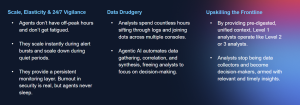
To address these challenges, SOCs are adopting architectures where AI agents act as force multipliers. This is not just about speed, it’s about learning, scalability, and availability.
The Cisco perspective: XDR meets Splunk agentic intelligence
“Cisco is uniquely positioned to turn this architectural theory into reality by combining the breadth of Cisco XDR with the depth of Splunk.”
Cisco XDR: The Orchestration Engine
Cisco XDR acts as the foundation for collecting and processing of supported systems, providing a SOAR platform with playbooks that run continuously or on demand.
It serves as the connector of systems in the environment, ensuring that when an agent identifies a threat, we link that up with data from the other disparate systems, including intelligence sources and threat feeds. The system can then instruct infrastructure components to take action.
Cisco Splunk: The Platform for Security, Observability & Agentic
By integrating with Cisco Splunk, the SOC gains a specialized solution for total observability. Splunk’s new agentic capabilities mean you have digital entities programmed to be ‘always-on’ – reviewing logs, hunting for anomalies, and listening across the entire telemetry stack 24/7.
Splunk is a scalable big data platform designed to collect, index, and analyze massive volumes of data in real time. Unlike traditional databases, it uses a scheme on read architecture, meaning you can ingest raw, unstructured data (logs, metrics, and traces) from any source in any location.
It has evolved into the central engine for unified observability and security, and providing the capabilities to visualize and turn this telemetry into proactive business insights and autonomous incident resolutions.
Splunk for the Agentic SOC
“The true power of an Agentic SOC lies in the ability to move from reactive searching to proactive operations.”
By integrating specialized AI agents directly into the Splunk security and observability portfolio, we bridge the gap between massive data and human bandwidth. We are moving toward an architecture where AI Agents function as autonomous, adaptable, and goal-oriented teammates. Unlike static scripts or workloads, these agents use reasoning to plan and execute complex workflows, ensuring the SOC can scale to meet any threat volume.
Splunk is transcending traditional AI-enabled SIEM and SOAR capabilities with –
- Triage Agent: This AI-powered agent evaluates, prioritizes, and explains alerts by surfacing what matters most and automating the initial look. It significantly reduces analyst workload and cognitive fatigue.
- Malware Reversal Agent: In seconds, this agent provides a line-by-line explanation of malicious scripts. It can extract indicators of compromise (IOCs), flag evasion techniques, and group behaviors, turning hours of manual engineering into an instant and actionable summary.
- Autonomous Operations for Low Severity: By delegating low-severity incidents to agentic tools, the SOC can operate proactively. These agents act autonomously to troubleshoot and accelerate investigations, significantly reducing Mean Time to Detect(MTTD) and Mean Time to Resolve (MTTR).
- Query Assistance: Translating natural language into complex SPL or API calls, removing the syntax tax that I mentioned.
- Guided Investigation: Walking the operator through a lead, suggesting next steps based on the reasoning of the Agentic brain
The guardrails: Trust and the human-in-the-loop
Even with autonomous capabilities, we aren’t handing over the keys to the SOC. After all, architecture without governance is a liability.
The trust score: Agentic AI tools operate within a Trust Framework. An agent might have the autonomy to gather data and build a timeline, but it won’t have 100% authority to perform high-impact actions, like shutting down a core interface or wiping a user’s account without a human consultation.
The general, not the front-line soldier: The goal is to move the human from doing the work to verifying the work. The human remains the essential final check, focusing on high-level direction while the agents handle the recursive multi-step process of alert triage.
The business case for the Agentic SOC isn’t about replacing people – it’s a matter of extending their reach. By absorbing the noise and scaling without fatigue, agentic systems remove the operational ceiling that has constrained security teams for years. Human expertise is no longer diluted by volume, it is concentrated where it delivers the most value. To me, that’s the real shift – not fewer humans, but greater impact per human. That’s how security scales without burning out.
#AgenticSOC #CyberSecurity #Splunk #AIinSecurity #CiscoAI #CiscoSecurity


